Grade Level: Grade Two
Topic: Truth and Reconciliation
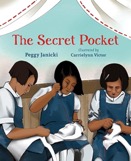
Book Title: “The Secret Pocket”
Author: Peggy Janicki
Link to Purchase: https://a.co/d/44MRqh6
Link for Online Read-Aloud : Not available on Youtube, but it is on Epic at https://www.getepic.com/book/92725173/the-secret-pocket
Teacher Resource Videos: https://youtu.be/8nD1DozPdt0?si=dFaEwyK5Z0B3E38M
https://youtu.be/MK3A3kDB93A?si=eYRWHiGX2VqEy4Td c
- Before Reading
- “Do you have a hiding place for treasures? What sort of things do you put in it?”
- “What kinds of places are good hiding spots for tiny toys? Money? Snacks?”
- During/After Reading
- “What would it be like if you had to go to school away from home? How would you feel if you had to leave your family?”
- “How would you feel if you had to wear the same clothes as everyone else?” (If at a uniform school, “How does it feel to come to school wearing the same clothes as your classmates?”)
- “What would be like if you had a rule about cutting your hair off to go to school?”
- “What are some of the important things that the little girl in the story learned from, and did with, her family?”
- “The children in the story didn’t have enough to eat, and couldn’t get food when they were hungry. They used their skills from their families to sew secret pockets into their clothes, and this helped them to hide away enough food for themselves and for others. That took courage! Do you think it was easy or hard to be brave like this?”
Follow-Up Activity:
- Create pockets for class treasures! If your class uses desk pets, incentive prizes, or something similar, have students create little pockets or containers to keep their treasures safe. If you can access scrap fabric, sewing needles and thread, and volunteers to help the students sew, this is a great way to practice a new skill. If that isn’t something that would be possible, you can make or create pocket envelopes or boxes from paper to meet the same purpose.
- Have the class make a collaborative list of games or activities at school that they enjoy (recess, choice time, puzzles, art, Lego, etc), and place each suggestion in a jar/bowl/container. Each day, choose one or two activities to do as a class until everyone’s activity has been used! There will likely be a sense of disappointment each time a student’s choice isn’t the pick. This is a very good reminder of the fact that different people find happiness in different things, and that it is important that everyone get to do the things that are important to them. I highly recommend that this be a “bonus play time”, rather than any regularly scheduled play, so that children are all playing together, and everyone will still have free choice as usual in the day.
BC Core Competency Connections:
Personal and Social
- Positive Personal and Cultural Identity
- I am aware of myself as different from others.
- Social Awareness and Responsibility
- I am aware that other people can be different from me.
- In familiar settings, I can interact with others and my surroundings respectfully.
- I can identify when something is unfair to me or to others.
Thinking
- Creative Thinking
- I get ideas when I use my senses to explore.
- Critical Thinking
- I can explore with a purpose in mind and use what I learn.
Communication
- Communicating
- In familiar settings, I communicate with peers and adults.
- I can understand and share basic information about topics that are important to me.
- Collaborating
- In contribute during group activities, cooperate with others, and listen respectfully to their ideas.
BC Curricular Connections:
- Understand (Big Ideas):
- Stories and other texts help us learn about ourselves and our families. (ELA 2)
- Everyone has a unique story to share. (ELA 2)
- Through listening and speaking, we connect with others and share our world. (ELA 2)
- Local actions have global consequences, and global actions have local consequences. (SS 2)
- Individuals have rights and responsibilities as global citizens, (SS 2)
- People connect to the hearts and minds of others in a variety of places and times through the arts. (Arts Education 2)
- Know (Content):
- Diverse characteristics of communities and cultures in Canada and around the world. (SS 2)
- Rights and responsibilities of individuals regionally and globally. (SS 2)
- Cultural and social awareness, achieved by exploring self-identity, acknowledging cultural differences, honouring indigenous traditions. (Career Education 2)
- Personal and collective responsibility associated with creating, experiencing, or sharing in a safe learning environment. (Arts Education 2)
- Do (Curricular Competency):
- Comprehend and connect (reading, listening, viewing)
- Engage actively as listeners, viewers, and readers, as appropriate, to develop understanding of self, identity, and community. (ELA 2)
- Demonstrate awareness of the role that story plays in personal, family, and community identity. (ELA 2)
- Use personal experience and knowledge to connect to stories and other texts to make meaning. (ELA 2)
- Show awareness of how story in First Peoples cultures connects people to family and community. (ELA 2)
- Create and communicate (writing, speaking, representing)
- Exchange ideas and perspectives to build shared understanding. (ELA 2)
- Recognize causes and consequences of events, decisions, or developments in their lives. (SS 2)
- Explain why people’s beliefs, values, worldviews, experiences, and roles give them different perspectives on people, places, issues, or events. (SS 2)
- Make value judgements about events, decisions, or actions, and suggest lessons that can be learned. (SS 2)
- Share ideas, information, personal feelings, and knowledge with others. (Career Education 2)
- Develop and demonstrate respectful behaviour when participating in activities with others. (Physical and Health Education 2)
- Create artistic works collaboratively and as an individual, using ideas inspired by imagination, inquiry, experimentation, and purposeful play. (Arts Education 2)
- Comprehend and connect (reading, listening, viewing)
FPPL Link:
- Learning ultimately supports the well-being of the self, the family, the community, the land, the spirits, and the ancestors.
- Learning involves recognizing the consequences of one’s actions.
- Learning is embedded in memory, history, and story.
- Learning requires exploration of one’s identity.
BC ELF Link:
- Early years spaces are inclusive.
- Play is integral to well-being and learning.
- Relationships are the context for well-being and learning.
- Learning is holistic.
TFT Through-line Link:
- Justice Seeking
- Community Building
 Social Justice for Little Learners
Leave a comment