Grade Level: Grade One
Topic: Indigenous Issues (Relationship to Land, Knowledge Sharing, Relationship with Elders)
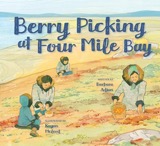
Book Title: “Berry Picking at Four Mile Bay”
Author: Barbara Adjun
Link to Purchase: https://a.co/d/aWlYKpu
Link for Online Read-Aloud : https://youtu.be/Tdx4hHjoIbY?si=SzcTr21NUujnPy5s
Discussion Prompts/Questions:
- Before Reading
- “In this book, Nekaloakyok tells about a time when she went with her family to go berry picking. Have you ever been to a place to pick berries?”
- “What are some important things that you can teach to someone else?”
- “What are important things that grown-ups have taught to you?”
- During/After Reading
- “Nekaloakyok teaches us about the history of her community and her family. What is something you can tell about the history of your community or family?”
- “In this story, the Mom packs the healthy food, and the child packs the snacks. What snacks would you choose to take for a big adventure?”
- “We learn from each other, and we learn a lot from people who are not the same age as us, or are not from the same place as we are! Did you notice that the granny was teaching the aunties and the mom, and all of the adults were teaching the little girl? We learn many important things from our Elders, and this is a very important part of many Indigenous cultures.”
- “Sometimes knowledge gets lost, either because people aren’t allowed to use it or they just forget because their world changes. What is important information that you hope you never forget?”
Follow-Up Activity:
- Arrange a “preschool playdate”, or an opportunity for younger siblings to visit the classroom for playtime. Encourage students to teach the younger children something new.
- If possible, arrange for older students visit your class to teach your students some new outdoor activities.
- Invite grandparents (or people from a grandparent generation) to come in and teach students some games they enjoyed playing when they were children.
BC Core Competency Connections:
Personal and Social
- Positive Personal and Cultural Identity
- I am aware of different aspects of myself. I can describe my family, home, and/or community (people and/or place).
- Social Awareness and Responsibility
- I am aware that other people can be different from me.
- I can identify when something is unfair to me or to others.
Thinking
- Creative Thinking
- I get ideas when I use my senses to explore.
- Critical Thinking
- I can explore materials and actions.
Communication
- Communicating
- In familiar settings, I communicate with peers and adults.
- I can understand and share basic information about topics that are important to me.
- Collaborating
- In familiar situations, I can participate with others.
- In familiar situations, I cooperate with others for specific purposes.
BC Curricular Connections:
- Understand (Big Ideas):
- Stories and other texts help us learn about ourselves and our families. (ELA 1)
- Everyone has a unique story to share. (ELA 1)
- Through listening and speaking, we connect with others and share our world. (ELA 1)
- Healthy communities recognize and respect the diversity of individuals and care for the local environment. (SS 1)
- Strong Communities are the results of being connected to family and community and working together towards common goals. (Career Education 1)
- Know (Content):
- Diverse cultures, backgrounds, and perspectives within the local and other communities. (SS 1)
- Cultural and social awareness, achieved by exploring self-identity, acknowledging cultural differences, honouring indigenous traditions. (Career Education 1)
- Do (Curricular Competency):
- Comprehend and Connect
- Engage actively as listeners, viewers, and readers, as appropriate, to develop understanding of self, identity, and community. (ELA 1)
- Recognize the importance of story in personal, family, and community identity. (ELA 1)
- Show awareness of how story in First Peoples cultures connects people to family and community. (ELA 1)
- Acknowledge different perspectives on people, places, issues, or events in their lives. (SS 1)
- Identify fair and unfair aspects of events, decisions, or actions in their lives and consider appropriate courses of action. (SS 1)
- Comprehend and Connect
FPPL Link:
- Learning ultimately supports the well-being of the self, the family, the community, the land, the spirits, and the ancestors.
- Learning is holistic, reflexive, reflective, experiential, and relational (focused on connectedness, on reciprocal relationships, and a sense of place).
- Learning involves generational roles and responsibilities.
- Learning recognizes the role of Indigenous knowledge.
- Learning is embedded in memory, history, and story.
BC ELF Link:
- Families have the most important role in contributing to children’s well-being and learning.
- People build connection and reconnection to land, culture, community and place.
- Play is integral to well-being and learning.
- Relationships are the context for well-being and learning.
TFT Through-line Link:
- Justice Seeking
- Community Building
- Servant Working
 Social Justice for Little Learners
Leave a comment