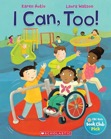
Grade Level: PS 3 and PS 4
Topic: Diverse Abilities
Book Title: “I Can, Too!”
Author: Karen Autio
Link to Purchase: https://a.co/d/0tl7W48
Link for Online Read-Aloud : * no read-aloud link available yet…stay tuned!
Discussion Prompts/Questions:
- “Piper and Kayla both love to move and play! Kayla needs some tools to help her with some of her moves. What tools did you notice in this book?”
- “What are tools we might use to help us move in different ways?” (strollers for children who can’t walk, strider bikes, training wheels, wheelchairs, leg braces, etc)
Follow-Up Activity:
- Go outside to a nature space or the playground. Explore how many different ways, either like in the book or new ideas, students can move around in the space. If possible, include trikes/bikes, push-cars, wagons, strollers, and adaptive equipment.
BC Core Competency Connections:
Personal and Social
- Personal Awareness & Responsibility
- I can show a sense of accomplishment and joy, and express some wants, needs, and preferences. I can sometimes recognize my emotions.
- Positive Personal and Cultural Identity
- I am aware of myself as different from others.
- Social Awareness and Responsibility
- I am aware that other people can be different from me.
- I can help and be kind.
Thinking
- Creative Thinking
- I get ideas when I play.
- Critical Thinking
- I can explore materials and actions.
Communication
- Communicating
- In a safe and supported environment, I respond meaningfully to communication from peers and adults.
- I can understand and share basic information about topics that are important to me.
- Collaborating
- In familiar situations, I can participate with others.
BC Curricular Connections:
- Understand (Big Ideas):
- Everyone has a unique story to share. (ELA K)
- Curiosity and wonder lead us to new discoveries about ourselves and the world around us. (ELA K)
- Our communities are diverse and made of individuals who have a lot in common. (SS K)
- Stories and traditions about ourselves and our families reflect who we are and where we are from. (SS K)
- Confidence develops through the process of self-discovery. (Career Education K)
- Learning about ourselves and others helps us develop a positive attitude and caring behaviours, which helps us build healthy relationships. (Physical and Health Education K)
- Know (Content):
- Ways in which individuals and families differ and are the same. (SS K)
- Rights, roles, and responsibilities of individuals and groups. (SS K)
- Cultural and social awareness, achieved by exploring self-identity, acknowledging cultural differences, honouring indigenous traditions. (Career Education K)
- Caring behaviours in groups and families. (Physical and Health Education K)
- Do (Curricular Competency):
- Comprehend and connect (reading, listening, viewing)
- Engage actively as listeners, viewers, and readers, as appropriate, to develop understanding of self, identity, and community. (ELA K)
- Recognize the importance of story in personal, family, and community identity. (ELA K)
- Create and communicate (writing, speaking, representing)
- Use language to identify, create, and share ideas, feelings, opinions, and preferences. (ELA K)
- Acknowledge different perspectives on people, places, issues, or events in their lives. (SS K)
- Identify fair and unfair aspects of events, decisions, or actions in their lives and consider appropriate courses of action. (SS K)
- Identify and appreciate their personal attributes, skills, interests, and accomplishments. (Career Education K)
- Share ideas, information, personal feelings, and knowledge with others. (Career Education K)
- Identify personal skills, interests, and preferences. (Physical and Health Education K)
- Develop and demonstrate respectful behaviours when participating in activities with others. (Physical and Health Education K)
- Comprehend and connect (reading, listening, viewing)
FPPL Link:
- Learning ultimately supports the well-being of the self, the family, the community, the land, the spirits, and the ancestors.
- Learning is holistic, reflexive, reflective, experiential, and relational (focused on connectedness, on reciprocal relationships, and a sense of place).
- Learning involves patience and time.
- Learning requires exploration of one’s identity.
- Learning is embedded in memory, history, and story.
BC ELF Link:
- Children are strong, capable in their uniqueness, and full of potential.
- Early years spaces are inclusive.
- Play is integral to well-being and learning.
- Relationships are the context for well-being and learning.
TFT Through-line Link:
- Community Building
- Servant Working
 Social Justice for Little Learners
Leave a comment