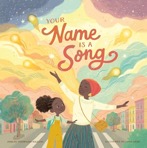
Grade Level: Grade One
Topic: Racial Identity and Racism
Book Title: “Your Name is a Song”
Author: Jamilah Thompkins-Bigelow
Link to Purchase: https://a.co/d/bBfr47p
Link for Online Read-Aloud : https://youtu.be/Cl-HNgbDyZk?si=O-0IQBTyukWeTkSF
Discussion Prompts/Questions:
- Before sharing the story, familiarize yourself with the pronunciations of the names. There is a guide at the back of the book, and I’ve also included a link. Don’t be afraid to make mistakes when pronouncing the names, but definitely do try! Pronunciations from the author: https://youtu.be/ZmXqJGherE8?si=iU0SdeloTX6KhXvB
- Before reading, have students share their own names (even if the class already knows them!), and tell something they like about their names.
- “Imagine if no one ever said your name correctly. How do you think you would feel?” Emphasize the importance of honouring and respecting peoples’ names, and that doing our best to say names correctly is part of this honour and respect.
- Have students say the names of the different children in the book as you go through the story.
Follow-Up Activity:
- Invent name songs! Have students think about their own names…syllables, letter sounds, etc…and create a song and/or rhythm for their name. Encourage students to share their name songs/sounds, and, if possible, record these and share them with class families.
BC Core Competency Connections:
Personal and Social
- Positive Personal and Cultural Identity
- I am aware of myself as different from others.
- Social Awareness and Responsibility
- I am aware that other people can be different from me.
- In familiar settings, I can interact with others and my surroundings respectfully.
- I can identify when something is unfair to me or to others.
Thinking
- Creative Thinking
- I get ideas when I use my senses to explore.
- Critical Thinking
- I can explore with a purpose in mind and use what I learn.
Communication
- Communicating
- In familiar settings, I communicate with peers and adults.
- I can understand and share basic information about topics that are important to me.
- Collaborating
- In contribute during group activities, cooperate with others, and listen respectfully to their ideas.
BC Curricular Connections:
- Understand (Big Ideas):
- Stories and other texts help us learn about ourselves and our families. (ELA 1)
- Everyone has a unique story to share. (ELA 1)
- Through listening and speaking, we connect with others and share our world. (ELA 1)
- Healthy communities recognize and respect the diversity of individuals and care for the local environment. (SS 1)
- Learning about ourselves and others helps us develop a positive attitude and caring behaviours, which helps us build healthy relationships. (Physical and Health Education 1)
- People create art to express who they are as individuals and community. (Arts Education 1)
- People connect to others and share ideas through the arts. (Arts Education 1)
- Know (Content):
- Diverse cultures, backgrounds, and perspectives within the local and other communities. (SS 1)
- Rights, roles, and responsibilities of individuals and groups. (SS 1)
- Cultural and social awareness, achieved by exploring self-identity, acknowledging cultural differences, honouring indigenous traditions. (Career Education 1)
- Caring behaviours in groups and families. (Physical and Health Education 1)
- Express feelings, ideas, stories, observations, and experiences through the arts. (Arts Education 1)
- Do (Curricular Competency):
- Comprehend and connect (reading, listening, viewing)
- Engage actively as listeners, viewers, and readers, as appropriate, to develop understanding of self, identity, and community. (ELA 1)
- Recognize the importance of story in personal, family, and community identity. (ELA 1)
- Use personal experience and knowledge to connect to stories and other texts to make meaning. (ELA 1)
- Create and communicate (writing, speaking, representing)
- Exchange ideas and perspectives to build shared understanding. (ELA 1)
- Recognize causes and consequences of events, decisions, or developments in their lives. (SS 1)
- Acknowledge different perspectives on people, places, issues, or events in their lives. (SS 1)
- Identify fair and unfair aspects of events, decisions, or actions in their lives and consider appropriate courses of action. (SS 1)
- Share ideas, information, personal feelings, and knowledge with others. (Career Education 1)
- Develop and demonstrate respectful behaviour when participating in activities with others. (Physical and Health Education 1)
- Personal and collective responsibility associated with creating, experiencing, or sharing in a safe learning environment. (Arts Education 1)
- Comprehend and connect (reading, listening, viewing)
FPPL Link:
- Learning ultimately supports the well-being of the self, the family, the community, the land, the spirits, and the ancestors.
- Learning involves recognizing the consequences of one’s actions.
- Learning is embedded in memory, history, and story.
- Learning requires exploration of one’s identity.
BC ELF Link:
- Early years spaces are inclusive.
- Play is integral to well-being and learning.
- Relationships are the context for well-being and learning.
- Learning is holistic.
TFT Through-line Link:
- Justice Seeking
- Community Building
 Social Justice for Little Learners
Leave a comment