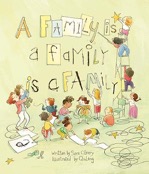
Grade Level: Grade Two
Topic: Family Diversity
Book Title: “A Family is a Family is a Family”
Author: Sara O’Leary
Link to Purchase: https://a.co/d/81bXJpA
Link for Online Read-Aloud : https://youtu.be/d338_UiXVwo?si=fv6OsPUStsr4_1Ie
Discussion Prompts/Questions:
- “Who is in your family?”
- “What does your family like to do together?”
- “What makes your family the same as other families? What makes your family different?”
- “The most important thing about a family is that they love each other, wherever they are. How can we still show that we love our families, even if they don’t live in the same house or city as we do?”
Follow-Up Activity:
- Have students use loose parts to represent their families. Find or make a house template that students can use. This can be a “make and take” if the you want them to attach items, or just a creation station. If possible, record short videos of the students telling about the families that they have created.
- Open a dramatic play house centre (ideally with racially diverse doll babies), where children can role-play being in a family.
- For other play opportunities, this is a good time to pull out a doll house, animal families, and other home centre type activities.
- For art, provide the opportunity for children to draw or paint pictures of their families and their homes.
- *Note: If your classroom does not have access to these sorts of dramatic play and/or toy centres, see if you can arrange for your students to be “big buddies” for a preschool or kindergarten class, and find a time when those teachers have these sorts of centres set up and timing can work for a playdate! Your older students will benefit from the experience of being the “big kids”, will benefit from this kind of play, and this will give you the opportunity to watch them put their kindness, empathy, and understanding into action.
BC Core Competency Connections:
Personal and Social
- Positive Personal and Cultural Identity
- I am aware of different aspects of myself. I can describe my family, home, and/or community (people and/or place).
- Social Awareness and Responsibility
- I can help and be kind.
- I am aware that other people can be different from me.
- In familiar settings, I can interact with others and my surroundings respectfully.
Thinking
- Creative Thinking
- I get ideas when I play.
- Critical Thinking
- I can explore materials and actions.
Communication
- Communicating
- In a safe and supported environment, I respond meaningfully to communication from peers and adults.
- Collaborating
- In familiar situations, I can participate with others.
BC Curricular Connections:
- Understand (Big Ideas):
- Stories and other texts help us learn about ourselves and our families. (ELA 2)
- Everyone has a unique story to share. (ELA 2)
- Through listening and speaking, we connect with others and share our world. (ELA 2)
- Strong communities are the results of being connected to family and community and working together toward common goals. (Career Education 2)
- Know (Content):
- Diverse characteristics of communities and cultures in Canada and around the world. (SS 2)
- Cultural and social awareness, achieved by exploring self-identity, acknowledging cultural differences, honouring indigenous traditions. (Career Education 2)
- Do (Curricular Competency):
- Comprehend and connect (reading, listening, viewing)
- Engage actively as listeners, viewers, and readers, as appropriate, to develop understanding of self, identity, and community. (ELA 2)
- Demonstrate awareness of the role that story plays in personal, family, and community identity. (ELA 2)
- Use personal experience and knowledge to connect to stories and other texts to make meaning (ELA 2)
- Create and communicate (writing, speaking, representing)
- Exchange ideas and perspectives to build shared understanding. (ELA 2)
- Create stories and other texts to deepen awareness of self, family, and community. (ELA 2)
- Explain why people’s beliefs, values, worldviews, experiences, and roles give them different perspectives on people, places, issues, or events. (SS 2)
- Recognize the importance of positive relationships in their lives. (Career Education 2)
- Identify and describe characteristics of positive relationships. (Physical and Health Education 2)
FPPL Link:
- Learning ultimately supports the well-being of the self, the family, the community, the land, the spirits, and the ancestors.
- Learning is holistic, reflexive, reflective, experiential, and relational (focused on connectedness, on reciprocal relationships, and a sense of place).
- Learning involves generational roles and responsibilities.
- Learning is embedded in memory, history, and story.
BC ELF Link:
- Families have the most important role in contributing to children’s well-being and learning.
- Early years spaces are inclusive.
- People build connection and reconnection to land, culture, community, and place.
- Play is integral to well-being and learning.
- Relationships are the context for well-being and learning.
TFT Through-line Link:
- Justice Seeking
- Community Building
 Social Justice for Little Learners
Leave a comment